
Inside Swix AI
- FeaturesChat, assistants, automations and agents, built for destination teams.
- Agents (AI Workforce)An agent team that plans the work, does it, and checks in when a person has to decide.
- AI AutomationsQuickFlows, ActionFlows and SmartFlows for the work you repeat.
- AssistantsCustom assistants that know your role, your files and your voice.
- ChatAsk in plain words, get back reports, decks and dashboards.
- AI knowledge baseOne library of your files that everything in Swix reads from.
- Security & TrustHow your data is encrypted, isolated and never used to train outside AI models.
 In their words30 min“What used to take me hours now takes me 30 minutes tops.”Jenna McCormick · Destination Creative & Content Manager, Visit Cheyenne
 AgentsPlans the work, does it, and stops for your okay.
 AI AutomationsA monthly board report, drafted in five numbered steps.
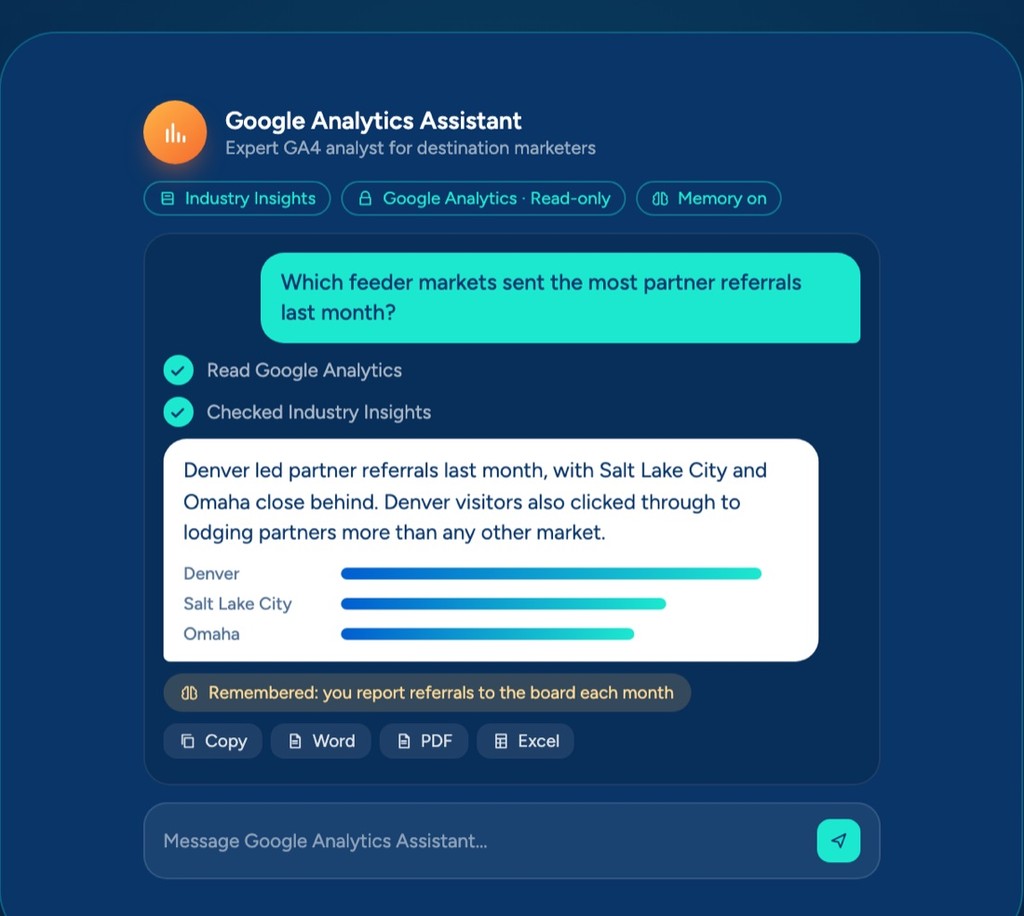 AssistantsAnswers from your Google Analytics, with read-only access.
 ChatOne prompt, a finished board report you can share.
 AI knowledge baseYour files, read by every assistant, agent and flow.
Swix AI
- Reading the inbox
- Drafting RFP replies
- Updating partner listings
- Agents on shift
- Swix
- AI
- Open
Home
BlogJan 29, 2026 · 3 min
What the 2026 Marketing AI Report Means for DMOs
The 2026 Marketing Talent AI Impact Report says AI is becoming the "baseline of the entire profession." Here's what that shift means for DMO teams, and why it's actually good news.

If you work at a DMO, you already know the reality: small teams, tight budgets, and a never-ending demand for content to keep your destination top of mind.
The new 2026 Marketing Talent AI Impact Report suggests that's about to shift in some pretty significant ways. Within the next year or two, AI won't just be something we dabble with. The report calls it the "baseline of the entire profession."
Here's what I think that means for destination marketers, and why I actually see it as good news for those willing to adapt.
From Making to Orchestrating
For years, DMO marketers have been judged by output. How many blogs written, ad performance, reels edited, emails sent. The report predicts that's changing as routine, lower-level work gets automated.
The new role? Orchestrator.
Instead of manually executing every task, you'll direct and verify AI workflows. This frees you to focus on the higher-level stuff: strategy, experience design, the work that actually moves the needle.
For a small DMO team that's always been stretched thin, this is basically the equivalent of gaining the headcount you've always wanted but couldn't afford.
Your Human Edge is Local Context
If AI can write a travel itinerary, do we still need DMO staff? I think the answer is absolutely yes, and the report backs this up. It emphasizes that while AI handles execution, human insight remains the differentiator.
AI hasn't tasted the espresso at your downtown cafe or watched the sunset from your favorite overlook. It lacks context. Your value now lies in the synthesis, judgment, and local knowledge that makes AI output actually useful.
You provide the soul; AI provides the scale.
Treat AI Agents Like Digital Co-Workers
The report suggests we stop viewing AI as just software and start treating AI agents as teammates with defined roles.
For DMOs, this means mapping out your workflows and identifying where an agent can step in. Maybe it's an agent responsible for auditing partner listings for accuracy. Or one that drafts initial responses to meeting inquiries. The idea is to integrate them into how your team actually operates, not as a novelty, but as a resource that handles the repetitive stuff so you can focus on what matters.
Rethink Your Agency Relationships
DMOs have always relied heavily on agency partners. But as in-house teams use AI to handle more production and research, the need to outsource routine work is shrinking.
The report recommends asking your agencies directly: how are you using AI, and are efficiency savings being passed to us? Your agency dollars should be going toward high-level strategy and breakthrough creativity, not commodity production that you can now handle internally.
Curiosity is Your New Currency
You don't need to be a coder to navigate this shift. The report identifies curiosity and adaptability as the top traits for future talent. Leaders are now prioritizing candidates who can unlearn and relearn over those who simply have ten years of traditional experience.
What I've found is that the marketers who lean in on AI aren't necessarily the most technical (myself included). They're the ones who are curious enough to experiment and figure out where it actually helps.
The Bottom Line
The goal isn't to use AI to just crank out more content. It's to shift your focus from making things to orchestrating experiences.
For DMO teams that have always done more with less, that shift might feel more natural than you'd expect.
BlogJan 29, 2026 · 3 min
What the 2026 Marketing AI Report Means for DMOs
The 2026 Marketing Talent AI Impact Report says AI is becoming the "baseline of the entire profession." Here's what that shift means for DMO teams, and why it's actually good news.
If you work at a DMO, you already know the reality: small teams, tight budgets, and a never-ending demand for content to keep your destination top of mind.
The new 2026 Marketing Talent AI Impact Report suggests that's about to shift in some pretty significant ways. Within the next year or two, AI won't just be something we dabble with. The report calls it the "baseline of the entire profession."
Here's what I think that means for destination marketers, and why I actually see it as good news for those willing to adapt.
From Making to Orchestrating
For years, DMO marketers have been judged by output. How many blogs written, ad performance, reels edited, emails sent. The report predicts that's changing as routine, lower-level work gets automated.
The new role? Orchestrator.
Instead of manually executing every task, you'll direct and verify AI workflows. This frees you to focus on the higher-level stuff: strategy, experience design, the work that actually moves the needle.
For a small DMO team that's always been stretched thin, this is basically the equivalent of gaining the headcount you've always wanted but couldn't afford.
Your Human Edge is Local Context
If AI can write a travel itinerary, do we still need DMO staff? I think the answer is absolutely yes, and the report backs this up. It emphasizes that while AI handles execution, human insight remains the differentiator.
AI hasn't tasted the espresso at your downtown cafe or watched the sunset from your favorite overlook. It lacks context. Your value now lies in the synthesis, judgment, and local knowledge that makes AI output actually useful.
You provide the soul; AI provides the scale.
Treat AI Agents Like Digital Co-Workers
The report suggests we stop viewing AI as just software and start treating AI agents as teammates with defined roles.
For DMOs, this means mapping out your workflows and identifying where an agent can step in. Maybe it's an agent responsible for auditing partner listings for accuracy. Or one that drafts initial responses to meeting inquiries. The idea is to integrate them into how your team actually operates, not as a novelty, but as a resource that handles the repetitive stuff so you can focus on what matters.
Rethink Your Agency Relationships
DMOs have always relied heavily on agency partners. But as in-house teams use AI to handle more production and research, the need to outsource routine work is shrinking.
The report recommends asking your agencies directly: how are you using AI, and are efficiency savings being passed to us? Your agency dollars should be going toward high-level strategy and breakthrough creativity, not commodity production that you can now handle internally.
Curiosity is Your New Currency
You don't need to be a coder to navigate this shift. The report identifies curiosity and adaptability as the top traits for future talent. Leaders are now prioritizing candidates who can unlearn and relearn over those who simply have ten years of traditional experience.
What I've found is that the marketers who lean in on AI aren't necessarily the most technical (myself included). They're the ones who are curious enough to experiment and figure out where it actually helps.
The Bottom Line
The goal isn't to use AI to just crank out more content. It's to shift your focus from making things to orchestrating experiences.
For DMO teams that have always done more with less, that shift might feel more natural than you'd expect.
Book a demo
Ready when you are.
Tell us where the hours go. We'll show you Swix working on your destination's real work, and what your first 60 days would look like.
No slides. No obligation.
Book a demo
Ready when you are.
Tell us where the hours go. We'll show you Swix working on your destination's real work, and what your first 60 days would look like.
No slides. No obligation.