
Inside Swix AI
- FeaturesChat, assistants, automations and agents, built for destination teams.
- Agents (AI Workforce)An agent team that plans the work, does it, and checks in when a person has to decide.
- AI AutomationsQuickFlows, ActionFlows and SmartFlows for the work you repeat.
- AssistantsCustom assistants that know your role, your files and your voice.
- ChatAsk in plain words, get back reports, decks and dashboards.
- AI knowledge baseOne library of your files that everything in Swix reads from.
- Security & TrustHow your data is encrypted, isolated and never used to train outside AI models.
 In their words30 min“What used to take me hours now takes me 30 minutes tops.”Jenna McCormick · Destination Creative & Content Manager, Visit Cheyenne
 AgentsPlans the work, does it, and stops for your okay.
 AI AutomationsA monthly board report, drafted in five numbered steps.
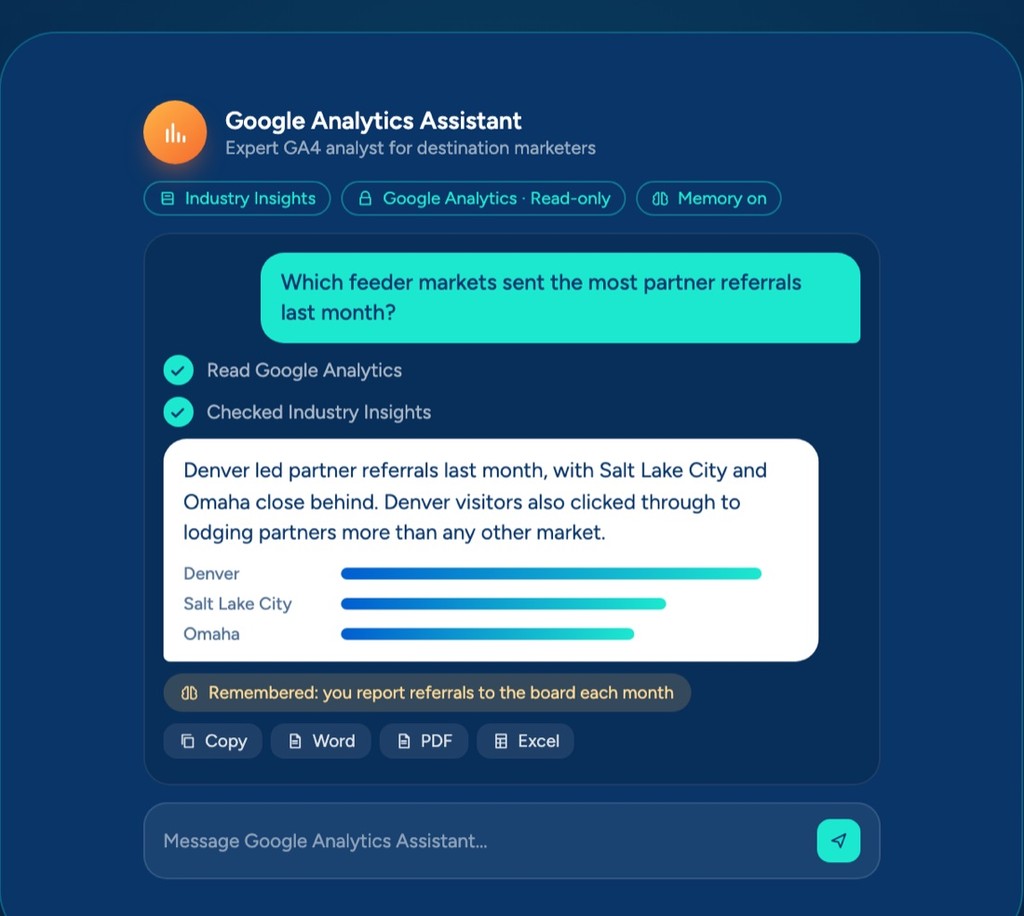 AssistantsAnswers from your Google Analytics, with read-only access.
 ChatOne prompt, a finished board report you can share.
 AI knowledge baseYour files, read by every assistant, agent and flow.
Swix AI
- Reading the inbox
- Drafting RFP replies
- Updating partner listings
- Agents on shift
- Swix
- AI
- Open
Home
AI governance.
Last updated October 3, 2026
Our approach
Swix AI builds AI tools for destination marketing organizations, tourism boards and convention and visitors bureaus. Teams use Swix to create and run AI assistants, automations and agents for content, sales, partner work and day-to-day operations.
This policy explains how we approach responsible AI. It covers the technology behind Swix, the commitments we make and the part our customers play. The binding terms between Swix AI and a customer are in our Master Services Agreement and Data Processing Addendum, and this policy doesn't change them.
Our principles
- People direct the work. AI on Swix works for people. Your team decides what to build, what it does and how much it does on its own.
- You stay in control. You own your data and your outputs, and you decide how your assistants and agents behave.
- We're clear about limits. We aim to be plain about how Swix uses AI, what it does well and where it falls short.
- Your data stays yours. We use customer data only to provide the service, and we don't let AI model providers train on it.
- We stand behind what we build. We take responsibility for the platform, review our practices as the technology and the law change, and welcome feedback.
The technology behind Swix
Swix AI doesn't build its own foundation models. Swix runs on large language models from established AI providers, and those models power the assistants, automations and agents you build.
When you add documents to a knowledge base, the content is turned into embeddings and stored with a vector database provider so the AI can find the right information. Our own software ties these pieces together and connects them to the tools your team authorizes, such as email, calendars and your CRM.
A list of our current providers is available on request at privacy@swix.ai.
How much the AI does on its own
AI tools differ in how much they do without a person. Swix covers a range, and you choose where each tool you build sits. The more a tool does on its own, the more it matters that a person stays in control.
- Assistive. A person asks, the AI drafts an answer, and the person decides what to do with it. Chat and QuickFlows work this way.
- Automated. A person starts a fixed, step-by-step process and the AI carries it out. ActionFlows work this way. The steps are predictable, and a person reviews the result.
- Orchestrated. Workflows that can branch, repeat and use connected tools. SmartFlows work this way, and they can pause at checkpoints for a person to review or approve before they continue. You decide where those checkpoints go.
- Agentic. AI Workforce agents can run on a schedule or when something happens, make decisions based on context, and take actions such as drafting messages or updating connected systems. You set what each agent can do, what starts it and where it needs approval.
At every level, you choose how much the AI does and how much oversight it gets. Swix is designed so the actions with the biggest consequences can sit behind a human review.
Human oversight
AI output is a prediction, not a fact. It can be wrong, incomplete or out of date, so a person should review it before it's relied on, published or acted on.
- Review before use. Customers are responsible for checking AI output before they use it.
- Safer defaults. Where Swix can take an action that reaches the outside world, it's designed to favor the safer option, such as creating a draft for a person to review instead of sending it.
- Checkpoints you control. You can add approval steps to workflows and agents, and we recommend it anywhere an agent can do something consequential.
Data privacy in AI processing
We use customer data only to provide and support Swix. We don't sell customer data, and we don't allow our AI model providers to use customer data or outputs to train their generally available models, unless the customer agrees in writing or the law requires it.
Knowledge base content is stored as embeddings and kept separate for each customer. Our full data protection commitments are in our Privacy Policy and Data Processing Addendum.
Accuracy and limits
Swix is a capable tool, but it isn't a substitute for human judgment. AI output may be wrong or out of date, and it isn't legal, financial, medical or other professional advice. Check important information and use your own judgment before acting on it.
Fairness and bias
Language models learn from huge amounts of text and can reflect the biases in it. We reduce that risk by choosing reputable model providers, designing prompts and workflows that encourage balanced and accurate results, and keeping people in the loop.
Customers play a big part too. Please review AI output for fairness and accuracy, especially content that will reach the public or affect decisions about people.
Uses we don't support
Swix is built for legitimate destination marketing and operations work. Customers may not use Swix to
- create or share deceptive content, including fake reviews or fake testimonials
- create deepfakes or impersonate a real person or organization
- produce or knowingly spread disinformation
- create content that is discriminatory, harassing or hateful
- infringe intellectual property or violate anyone's privacy or other rights
- carry out unlawful surveillance or profiling of individuals
- send unlawful or deceptive marketing messages
- do anything else that's unlawful or breaks our agreements
Where the law requires AI-generated content to be labeled as such, customers are responsible for labeling it.
What we ask of customers
Responsible AI is a partnership. Customers are responsible for
- reviewing AI output before relying on it, publishing it or acting on it
- choosing how much each agent does on its own and setting the right oversight
- not adding regulated or sensitive data, such as health or payment card data, unless we've agreed to it in writing
- labeling AI-generated content where the law requires it
- using Swix lawfully and within our Terms and agreements
Reviews and updates
AI technology and the laws around it are changing quickly. We review this policy and our practices regularly, and whenever a significant change calls for it. We'll post material updates on this page.
Contact
Questions about this policy can go to info@swix.ai, or by mail to Swix AI, LLC, 1846 E. Innovation Park Dr., Suite 500 PMB 5004, Oro Valley, AZ 85755.
AI governance.
Last updated October 3, 2026
Our approach
Swix AI builds AI tools for destination marketing organizations, tourism boards and convention and visitors bureaus. Teams use Swix to create and run AI assistants, automations and agents for content, sales, partner work and day-to-day operations.
This policy explains how we approach responsible AI. It covers the technology behind Swix, the commitments we make and the part our customers play. The binding terms between Swix AI and a customer are in our Master Services Agreement and Data Processing Addendum, and this policy doesn't change them.
Our principles
- People direct the work. AI on Swix works for people. Your team decides what to build, what it does and how much it does on its own.
- You stay in control. You own your data and your outputs, and you decide how your assistants and agents behave.
- We're clear about limits. We aim to be plain about how Swix uses AI, what it does well and where it falls short.
- Your data stays yours. We use customer data only to provide the service, and we don't let AI model providers train on it.
- We stand behind what we build. We take responsibility for the platform, review our practices as the technology and the law change, and welcome feedback.
The technology behind Swix
Swix AI doesn't build its own foundation models. Swix runs on large language models from established AI providers, and those models power the assistants, automations and agents you build.
When you add documents to a knowledge base, the content is turned into embeddings and stored with a vector database provider so the AI can find the right information. Our own software ties these pieces together and connects them to the tools your team authorizes, such as email, calendars and your CRM.
A list of our current providers is available on request at privacy@swix.ai.
How much the AI does on its own
AI tools differ in how much they do without a person. Swix covers a range, and you choose where each tool you build sits. The more a tool does on its own, the more it matters that a person stays in control.
- Assistive. A person asks, the AI drafts an answer, and the person decides what to do with it. Chat and QuickFlows work this way.
- Automated. A person starts a fixed, step-by-step process and the AI carries it out. ActionFlows work this way. The steps are predictable, and a person reviews the result.
- Orchestrated. Workflows that can branch, repeat and use connected tools. SmartFlows work this way, and they can pause at checkpoints for a person to review or approve before they continue. You decide where those checkpoints go.
- Agentic. AI Workforce agents can run on a schedule or when something happens, make decisions based on context, and take actions such as drafting messages or updating connected systems. You set what each agent can do, what starts it and where it needs approval.
At every level, you choose how much the AI does and how much oversight it gets. Swix is designed so the actions with the biggest consequences can sit behind a human review.
Human oversight
AI output is a prediction, not a fact. It can be wrong, incomplete or out of date, so a person should review it before it's relied on, published or acted on.
- Review before use. Customers are responsible for checking AI output before they use it.
- Safer defaults. Where Swix can take an action that reaches the outside world, it's designed to favor the safer option, such as creating a draft for a person to review instead of sending it.
- Checkpoints you control. You can add approval steps to workflows and agents, and we recommend it anywhere an agent can do something consequential.
Data privacy in AI processing
We use customer data only to provide and support Swix. We don't sell customer data, and we don't allow our AI model providers to use customer data or outputs to train their generally available models, unless the customer agrees in writing or the law requires it.
Knowledge base content is stored as embeddings and kept separate for each customer. Our full data protection commitments are in our Privacy Policy and Data Processing Addendum.
Accuracy and limits
Swix is a capable tool, but it isn't a substitute for human judgment. AI output may be wrong or out of date, and it isn't legal, financial, medical or other professional advice. Check important information and use your own judgment before acting on it.
Fairness and bias
Language models learn from huge amounts of text and can reflect the biases in it. We reduce that risk by choosing reputable model providers, designing prompts and workflows that encourage balanced and accurate results, and keeping people in the loop.
Customers play a big part too. Please review AI output for fairness and accuracy, especially content that will reach the public or affect decisions about people.
Uses we don't support
Swix is built for legitimate destination marketing and operations work. Customers may not use Swix to
- create or share deceptive content, including fake reviews or fake testimonials
- create deepfakes or impersonate a real person or organization
- produce or knowingly spread disinformation
- create content that is discriminatory, harassing or hateful
- infringe intellectual property or violate anyone's privacy or other rights
- carry out unlawful surveillance or profiling of individuals
- send unlawful or deceptive marketing messages
- do anything else that's unlawful or breaks our agreements
Where the law requires AI-generated content to be labeled as such, customers are responsible for labeling it.
What we ask of customers
Responsible AI is a partnership. Customers are responsible for
- reviewing AI output before relying on it, publishing it or acting on it
- choosing how much each agent does on its own and setting the right oversight
- not adding regulated or sensitive data, such as health or payment card data, unless we've agreed to it in writing
- labeling AI-generated content where the law requires it
- using Swix lawfully and within our Terms and agreements
Reviews and updates
AI technology and the laws around it are changing quickly. We review this policy and our practices regularly, and whenever a significant change calls for it. We'll post material updates on this page.
Contact
Questions about this policy can go to info@swix.ai, or by mail to Swix AI, LLC, 1846 E. Innovation Park Dr., Suite 500 PMB 5004, Oro Valley, AZ 85755.